Roadmap for Québec Society’s Transition to a Circular Economy 2025 –2050
RRECQ coordinates the Roadmap for Québec society's transition to a circular economy by 2050.
Objectives and Challenges
Over the course of two years (March 2023–March 2025), this project helped develop an ambitious roadmap to guide the transition to a circular economy in Quebec by 2050. Through an interdisciplinary, systemic, and participatory approach, supported by the methodological guidance of Chemins de transition, more than 330 people from diverse backgrounds were brought together to collectively envision a future that is both desirable and achievable, based on a profoundly different economic model.
Why a shared, long-term roadmap?
Because the transition to a circular economy requires profound changes across various societal dimensions—changes that can only be achieved over the course of a generation. This roadmap proposes a structured, evolving, and multisectoral path that aligns stakeholders’ efforts around a shared vision and provides concrete guidelines for taking action today. Serving as a true collective compass, it enables us to move step by step toward structural transformations, while maintaining the flexibility needed to adapt to changing circumstances.
Adopting a systemic approach is essential for coordinating and maximizing efforts. A common, multisectoral roadmap, driven by the diversity of those involved, fosters synergies, reduces the fragmentation of actions, and ensures the coherence necessary for a smooth and effective transition.
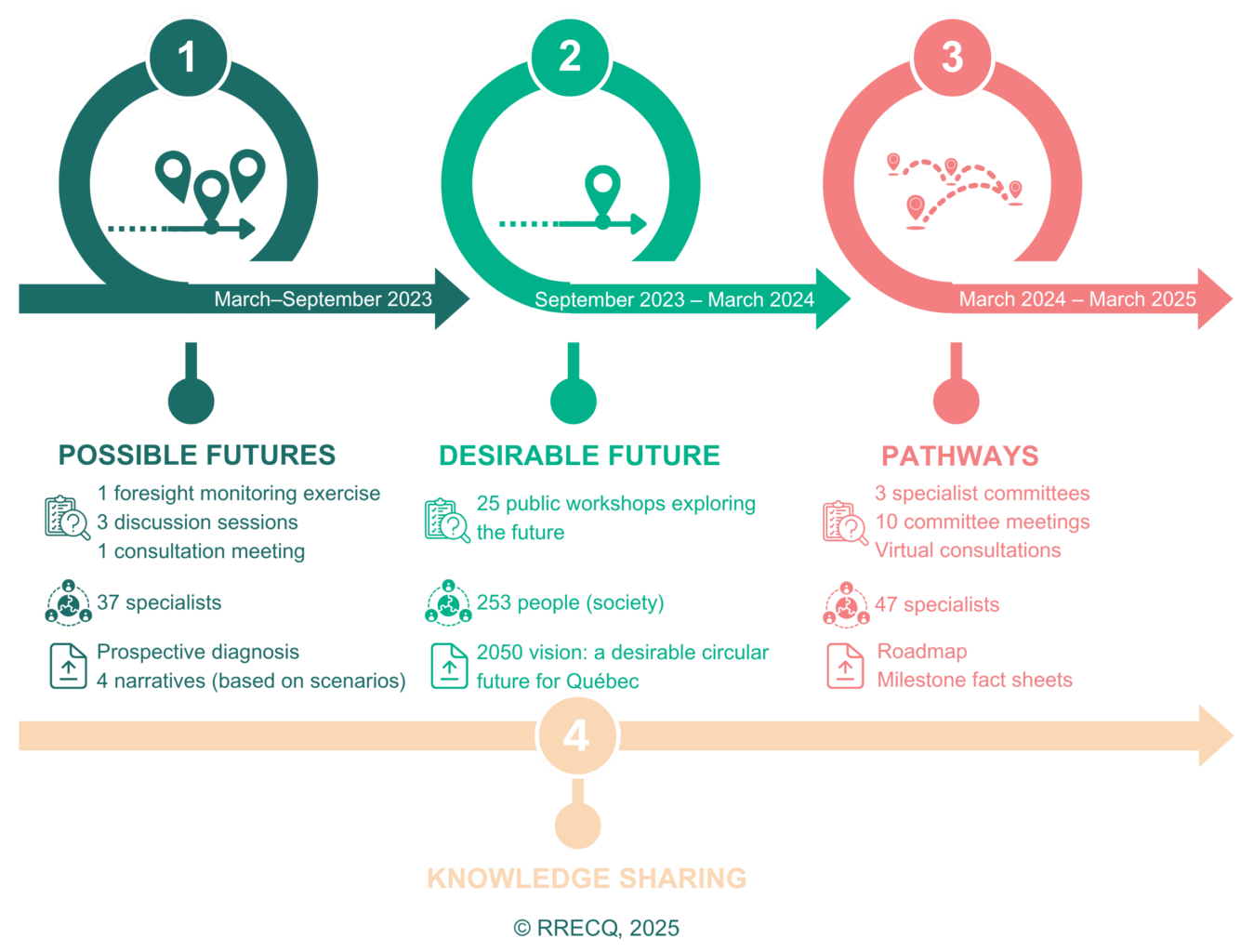
Accelerating a desired and co-created circular transition : A Four-Stage Process
Steps and Resources
Step 1. Possible Futurs
Prospective Diagnosis
Stories based on future scenarios (french only):
Noël 2050 : Mara et ses filles
Échanges au party des grandes retrouvailles 2050
Un Fab Lab en effervescence
Le monde de Gina
Step 2. Desirable Futur
Through a participatory process, the RRECQ developed a collective vision of the circular economy in Quebec in 2050. More than 250 people from diverse backgrounds participated in co-design workshops, along with some 50 experts who provided their informed perspectives on the ideas that emerged from the group discussions. Here are the results of this forward-looking exercise.
Step 3. Pathways
Step 3, called “Pathways,” brought together about 50 experts from 27 organizations, divided into three committees: Production, Consumption, and Governance. Their mission was to collaboratively develop pathways connecting the current state to the desired future in 2050 by identifying, linking, and scheduling milestones to be achieved between 2025 and 2050. These pathways help define starting points and serve as a guide as the global and local context evolves.
A total of 67 milestones have been identified to form the Transition Trajectory 2025-2050, linking the current situation to the desired future. Ten milestones play a strategic role in initiating this transition: these are the pivotal milestones.
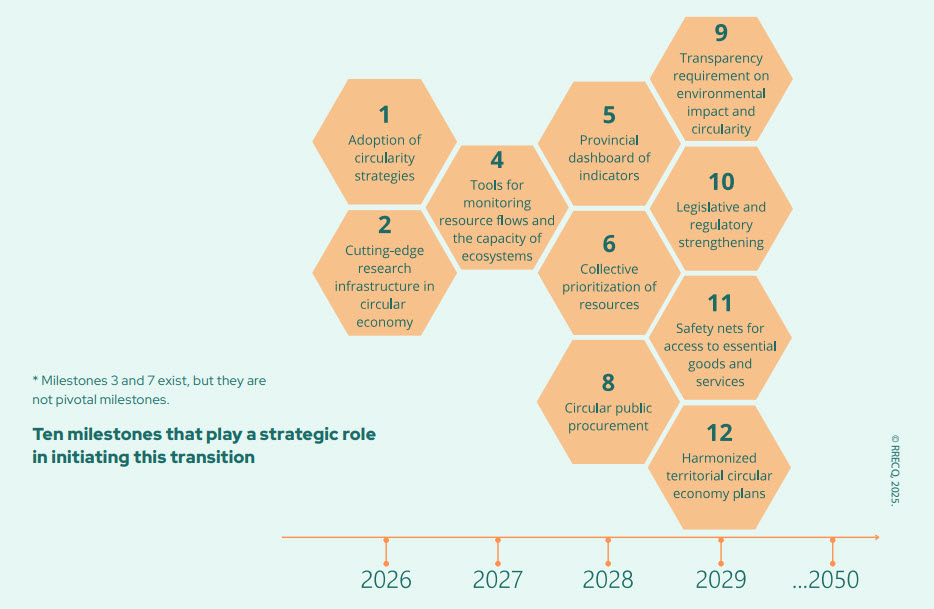
View the 67 milestones of the circular transition:
The 67 milestones shaping this transition
Milestone sheets
View the timelines for the three components:
2025–2050 Transition Pathway – Production Component (French Only)
2025–2050 Transition Pathway – Consumption Component (French Only)
2025–2050 Transition Pathway – Governance Component (French Only)
2025–2050 Transition Pathway – All Components (French Only)
Step 4. Knowledge Sharing
Finally, Step 4, titled “Knowledge Sharing,” has been integrated across the entire process to ensure the open and transparent dissemination of knowledge generated through the RRECQ website, its social media channels, and its newsletter. The RRECQ website allows stakeholders to track its progress and access the deliverables produced.
Final Road Map Report
Project Operations Team
Marlybell Ochoa Miranda
RRECQ
Project Manager, Lead for the Roadmap for Québec Society’s Transition to a Circular Economy 2025 –2050
Emmanuel Raufflet
RRECQ
Previous co-chair of the Axis 1 – Values, Transitions, and Change Management
Myriam Ertz
RRECQ
Co-Lead of Axis 1 – Values, Transitions, and Change Management
Benjamin Laplatte
RRECQ – Assistant Executive Director
Centre d’études et de recherches intersectorielles en économie circulaire (CERIEC) – Assistant Director
Cathy Baptista
RRECQ
Scientific Coordinator
Émilie Chiasson
CERIEC
Communications Advisor
Valérie Demers
RRECQ
Previous Project Manager
Élise Rucquoi
RRECQ
Previous Project Manager
Ghizlane Driouich
RRECQ
Research Assistant
The RRECQ would like to express its deep gratitude to everyone who contributed to this work. We would like to extend our special thanks to Chemins de transition, our methodological partner; to Marlybell Ochoa Miranda, project manager, who led this forward-looking roadmap initiative; to the operational team; to the team facilitating the public future exploration workshops; and to everyone who participated in these workshops. We also thank the members of the expert committee, who guided the development of the transition pathway during Step 3.
Experts commitee (in alphabetical order by first name) :
- Amélie Cote (Équiterre)
- Anne-Marie Corriveau (UdeS)
- Annie Ferlatte (Communautique, Fab Lab)
- Annie Levasseur (ETS, CERIEC)
- Aure Adell (ECPAR)
- Barbara Duroselle (TIESS)
- Caroline Boivin (UdeS)
- Catherine Gauthier-Dion (MAPAQ)
- Cathy Baptista (RRECQ)
- Cécile Bulle (UQAM)
- Chantal Rossignol (CERIEC)
- Chloé Steux (École Polytechnique (Paris))
- Chourouk Ouerghemmi (UQAC)
- Christophe Abrassart (UdeM)
- Claire Pédrot (Environnement Côte-Nord)
- Émilie Dupont (Synergie Québec, SADC du Kamouraska)
- Emmanuel Raufflet (HEC Montréal, RRECQ)
- Étienne Angers (RECYC-QUÉBEC)
- Gabrielle Gareau (Chantier de l’économie sociale)
- Gaëlle Généreux (PME MTL)
- Ghina El Haffar (McGill University)
- Gilles Parent (Repair Café Montréal)
- Hélène Gervais (RECYC-QUÉBEC)
- Hélène Lauzon (CPEQ)
- Hortense Montoux (CERIEC)
- Isabelle Lessard (Futur Simple)
- Isabelle Moïse (RECYC-QUÉBEC)
- Jeanne Desrosiers (Intern- MELCCCFP)
- Laura Grenier-Paquette (Synergie économique Laurentides)
- Luciano Barin Cruz (HEC Montréal)
- Marc Journeault (Université Laval, RRECQ)
- Marie-France Bellemare (Insertech)
- Martin Deron (UdeM, CdT)
- Mathias Glaus (ETS, RRECQ)
- Maude Vuillemard (MERN)
- Myriam Ertz (UQAC, RRECQ)
- Olivier Dulude (CPEQ)
- Para Radanielina (MAPAQ)
- Rafael Ziegler (HEC Montréal)
- Rayane Baitiche (MELCCCFP)
- Sabrina Cholette (BCDD- MELCCCFP)
- Sara Perez-lauzon (HEC Montréal)
- Sophie Bernard (Polytechnique Montréal, RRECQ)
- Stéphan Gagnon (MERN)
- Stephanie H. Leclerc (McGill University)
- Tasseda Boukherroub (ÉTS)
- Valérie Patreau (Polytechnique Montréal)
A transformation chosen by and for society
We must move toward a rapid and effective transition that involves all sectors of society in a transformation that is informed, thoughtful, debated, and, above all, chosen. It is in this spirit that the RRECQ has committed itself to this landmark project: a Roadmap for the Transition to a Circular Economy in Quebec society.