From Waste to Resource: A New Life for Smartphone Glass
Towards the Development of a Sustainable and Circular Economy Strategy for Waste Smartphone Glass – A Novel Remanufacturing Approach for E-waste Valorization
The team at ÉTS, led by Lucas Hof, analyzed the freeform micromachining of end-of-life chemically strengthened glass from smartphone screens. Discover the summary of their work.
Summary
In the context of sustainable development, numerous sources of waste are being studied for reuse. This is the case for electronic waste, where the short lifespan of mobile phones and frequent consumer upgrades have caused a dramatic increase in discarded devices over the past decades. Recycling these products by remanufacturing their components therefore seems an opportunity to be seized. However, the smartphone industry utilizes Chemically Strengthened Glass (CSG) for screens, a material engineered with a high surface compressive stress that makes it notoriously difficult to re-machine using conventional techniques without causing catastrophic fracturing. The Laboratory of Smart and Circular Manufacturing (LFIC) at ÉTS has adapted a hybrid technique, Spark Assisted Chemical Engraving (SACE), and sought to explore its potential to safely upcycle this high-value glass waste. The cutting quality and surface integrity of such a process are highly dependent on the electrical parameters, the cutting speed, and the electrolyte concentration.
The principal objective of this study is to explore the feasibility of the SACE process for the remanufacturing of end-of-life CSG. To do this, a robust experimental design was formulated to optimize the machining process. The glass was submerged in a potassium hydroxide (KOH) electrolyte, and a custom three-axis SACE machine was utilized. Three key process parameters, including, voltage, cutting speed, and KOH concentration, were varied and carefully analyzed to find the optimal balance for precision and surface finish.
The effects of the SACE process parameters on the glass were studied under several aspects using various characterization methods:
- Chipping
- Cut surface roughness (Sa)
- Cut kerf (machining width)
- Surface distance index (cut straightness)
- Edge roundness
The experimental results assure that SACE is a highly viable, single-step freeform machining process for CSG, successfully mitigating the catastrophic fracturing common in mechanical and laser-based methods. The optimized performance, yielding smooth surfaces and minimal defects, was achieved at 33 V, 5 µm/s, and 30 wt.% KOH. Figure 1 represents a macroscopic view of a long spiral cut, demonstrating the process’s ability to reliably produce complex freeform geometries. Furthermore, the statistical analysis revealed a strong synergistic effect between voltage (V) and the electrolyte concentration (C): high voltage significantly degrades surface quality, especially at higher KOH concentrations. The observation of the cut edges under a microscope highlighted the importance of parameter control. Figure 2 represents an optical observation of these edges, showing severe widespread chipping under extreme parameters (Figure 2e and f) compared to the clean, uniform surfaces achieved under optimal conditions (Figure 2g and h).
In order to ensure the industrial viability of the SACE technique for large-scale e-waste remanufacturing compared to its high-cost competitors (like femtosecond lasers), its capacity for parallel scalability and higher material removal rates using multi-tool arrays remains to be evaluated.
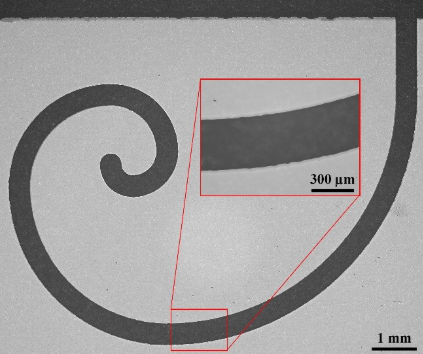
Figure 1: Demonstration of a complex freeform cut (spiral) on chemically
strengthened glass using optimized SACE parameters
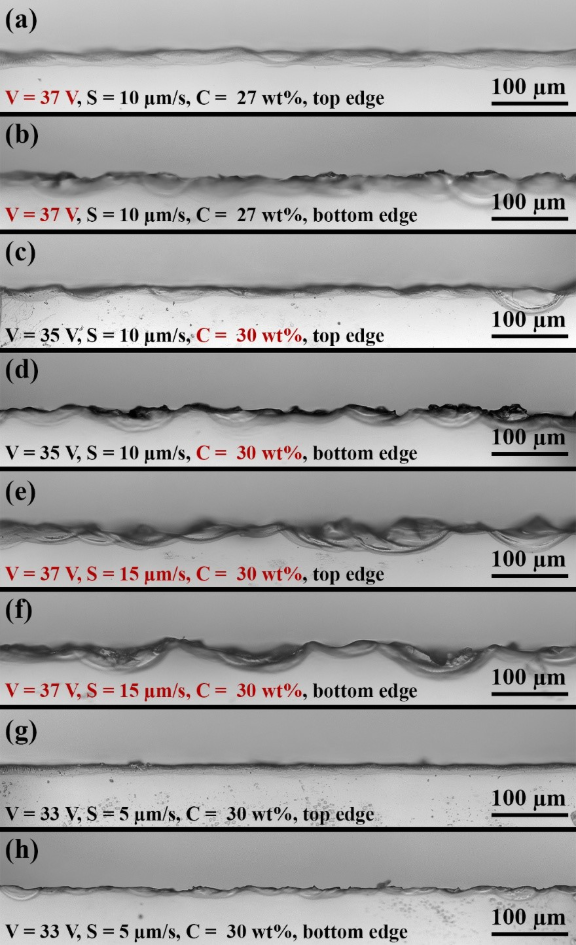
Figure 2: Microscopic observation of cut edges comparing severe chipping under suboptimal conditions (a-f) versus a clean cut under optimal parameters (g and h).