Measuring the circularity of wastewater treatment plants, based on local realities
Development of a dynamic circularity indicator for wastewater treatment plants taking into account local territorial specificities
Robert Hausler, profesor in the Department of Civil Enhineering at ÉTS, and his team led a project to develop a dynamic circularity indicator for wastewater treatment plants, with the aim of better utilizing recovered materials while complying with environmental requirements and regional specificities. Discover the summary of their work.
Summary
Current wastewater treatment plants are designed according to the principle of a chain of successive processes to meet government-set discharge standards. This principle leads to the design and operation of processes that minimize sludge production and reduce the quantity of solid waste and its management. The foundations of a circular economy are therefore not promoted by this approach.
In order to integrate the circular economy into wastewater treatment plants, the approach is based on a model inspired by the dynamics of natural ecosystems. Initially, the economic elements considered are the organic matter and nutrients in wastewater and, at the outlet, energy and food. A Sankey diagram was used to represent the potential gains from designing treatment scenarios to produce energy and food.
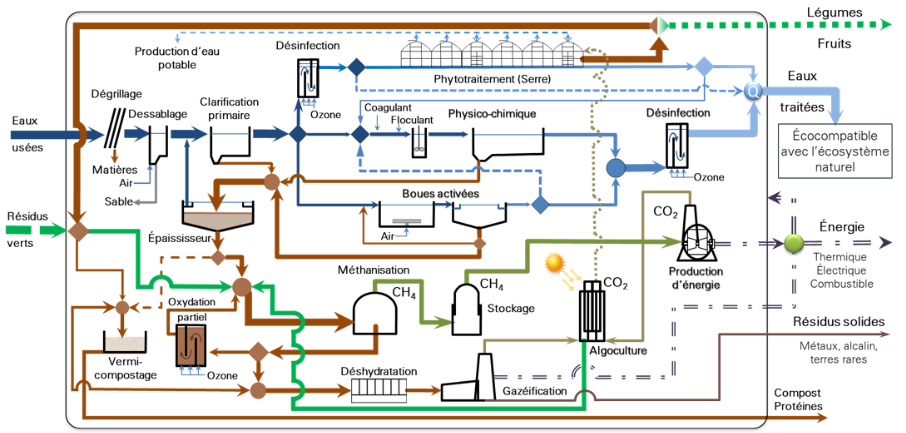
Figure 1.- Vision of a wastewater treatment plant based on the circular economy concept
The results of the scenarios considered (Figure 1) show that wastewater treatment and organic waste management must be centralized. Furthermore, a wastewater treatment plant should be considered as a network of different technologies (diversified technology). This result corresponds in nature to the link between a natural ecosystem and biodiversity. With this approach, treatment plants become more resilient in meeting discharge standards while producing energy and food.
In conclusion, the project results show that applying the functioning of natural ecosystems to wastewater treatment combined with organic waste management makes it possible to integrate certain elements of the circular economy. They also emphasize that monitoring of wastewater treatment plants must be more systematic and expanded to include parameters characterizing compounds and products of economic value in addition to environmental parameters. The application of the proposed concepts should result in lower wastewater treatment costs through the generation of revenue and a reduction in municipal taxes, while ensuring resilience in meeting treatment objectives. Finally, integrating the number of links and/or nodes in a system would allow for a better assessment of the degree of circularity in a system.