Rethinking urban energy to consume less and better
Optimization potential of local energy ecosystems: analysis from a circular economy perspective
Under the supervision of Annie Levasseur, professor in the Department of Construction Engineering at ÉTS, Patrick Lachapelle led a project aimed at better understanding how cities can optimize their local energy systems by applying the principles of the circular economy. Discover the summary of their work.
Summary
The project is set against the backdrop of the ecological, climate, and energy crises affecting Quebec and the planet as a whole. To address these issues, an energy transition will have to take place, based on the principles of energy conservation, energy efficiency, and renewable energy production.
Based on Quebec’s energy assets, such as abundant resources, and challenges, such as vulnerability and inefficiency, the research project takes a broader look at the role of local communities (cities) in this energy transition. Indeed, there is a close relationship between land use planning, urban infrastructure, stakeholder behavior, and the energy performance of communities.
ome studies show that through urban planning and land use choices, urban transportation systems and infrastructure, etc., cities could influence more than 70% of energy consumption and reduce emissions by more than 90% by 2050. Cities therefore have several levers at their disposal to increase renewable energy production or influence demand in order to create more sustainable living environments.
To clarify the potential actions of local authorities in terms of sustainability and local energy transition, the research project applies various concepts, principles, and approaches, such as the circular economy, the circular city, and urban metabolism, to the urban energy system. The articulation of these concepts allows us to view the city as a true ecosystem where several interconnected systems come together. In addition, the project incorporates a “socio-technical” perspective that recognizes energy demands as ‘derived’ demands, influenced by several factors or variables that can be called “drivers” of energy demands or services. The importance of these socio-technical contexts in energy performance is such that some researchers argue that what we need is not so much an energy transition as a transition in socio-technical systems. In this sense, “individual sobriety” could be ineffective and futile if we do not change the socio-technical contexts.
In transportation, for example, it may be more effective to focus on “collective sobriety” by developing high-quality active and collective transportation infrastructure, or by designing compact cities to encourage sober mobility behaviors (promoting active or collective mobility, etc.).
With a view to assisting decision-making, and based on environmental sustainability project management practices and extensive literature on the principles of energy transition, the circular economy, and the circular city, three main principles of transition emerge (sobriety, efficiency, renewable energies), from which four strategic objectives are proposed to “circularize” the local energy ecosystem:
- Shrink
- Slow down
- Bring closer together
- Regenerate
To optimize urban metabolism according to the principles and strategic objectives mentioned above, we must first clarify our understanding of the components of this ecosystem. The project proposes a conceptual diagram that articulates the four different systems: Human System, Built System, Mobility System, Natural and Food System, and their subsystems, which must be taken into account in any planning of the urban energy ecosystem.
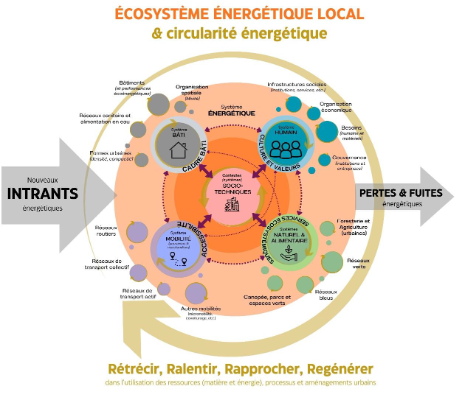
The organization and interaction between these systems and their subsystems are unique to each community, giving rise to specific socio-technical contexts that are at the heart of local energy systems (and performance) in communities. Obviously simplistic and incomplete, this diagram is primarily intended to stimulate reflection on the centrality of socio-technical systems (or contexts) and the multitude of subsystems that would need to be addressed if action were to be taken on this ecosystem to optimize it or reduce its consumption of materials or energy. More specifically, the research project then sets out to present an approach to planning the local energy ecosystem. As inspiration, the project reviews various frameworks from international agencies and case studies of circular planning in European municipalities, from which a 5-step planning process is proposed. As it has not been tested, this process should be applied in a real-world context to validate its relevance. In addition, a summary of interventions and means of implementing circularity, applied to energy flows, is presented to stimulate the imagination of planners and decision-makers. Finally, the project concludes with a list of several challenges, limitations, and contradictions in applying a circularity approach to optimize the local energy ecosystem.