
What if the sand and gravel we use to clean our streets in the spring could also be used as an abrasive in the winter—and save us money in the process? Professors Jean-François Audy and Amina Lamghari, along with their research team, studied the circularity potential of street sweepings for the manufacture of winter abrasives. Discover the summary of their work.
Summary
Every spring, thousands of tons of material are collected from Quebec’s roads during sweeping operations managed by public road authorities. These street sweepings, which consist mainly of sand and gravel used as abrasives during road winter maintenance, represent a valuable resource that can be, for instance, reused in the production of residue-based winter abrasives. Circular economy applied to these seasonal residues has two major benefits. First, it reduces the need to extract nonrenewable virgin material from quarries. Second, it lowers transportation and disposal costs, which in turn reduces greenhouse gas emissions.
To apply circular economy to the actual linear supply chain, a closed-loop supply chain must be designed as shown in Figure 1. Supported by an optimization model, the project aims to design a large-scale closed-loop supply chain in the province of Quebec according to the four scenarios detailed below. Specifically, the study area covers 11 administrative regions (about 123,500 km²) in which 80 road authorities manage a road network divided into approximately 4,000 services zones that both emit residues and consume abrasives. The study area also includes 1,052 quarries producing virgin abrasives, 36 recycling centers for sorting residues and mixing residue-based abrasives, 316 winter maintenance centers for abrasive storage and distribution, and 39 landfill sites.
To build such a realistic large-scale case, we first extracted many spatial and operational data from different sources and open databases. These data were then filtered, completed and mapped to identify the various infrastructure. After organizing the network, we distinguished the facilities shared by both authorities from those that are authority specific as well as their respective tonnage emit (residues) and consume (abrasives) in each service zone. Building on this foundation, we developed the scenarios below that define how materials move through such circular system.
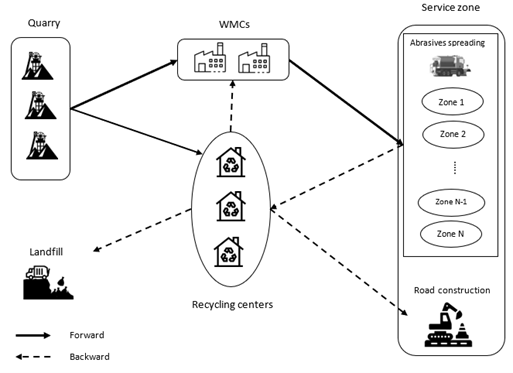
Despite this potential, circular-based practices and material management will likely not be coordinated across the province. Indeed, there are two main types of road authorities responsible for winter road maintenance: the regional centers of the provincial ministry of transportation and municipalities, regrouped in county regional municipalities in this project. The former take care of the superior road network (e.g., interurban highways and regional corridors) while the latter of the local road network within urban and suburban areas. Road authorities often operate independently, each relying on its own linear supply chain with facilities, capacities, and procedures. This fragmented approach can lead to inefficiencies and higher costs in their transition to a closed-loop supply chain. Improving collaboration between these authorities at the design phase of the circular system could significantly enhance both the economic and environmental performance of the proposed circular transition. To evaluate such collaborative logistics opportunity, two scenarios are defined:
- S1 – No collaboration: Each authority processes and manage its own residues of sweepings independently.
- S2 – Full collaboration: All residues of sweepings are pooled, and residues-based abrasive outputs can be distributed freely among authorities without restrictions.
Moreover, another key structural decision in the design of the closed-loop supply chain concerns the location of the mixing operation, a new required material process activity to enable the circular transition. In supply chain management, postponement refers to delaying a transformation activity to a downstream stage in order to improve flexibility, reduce unnecessary transportation, or enhance system-wide efficiency. Two different scenarios regarding the location of the mixing operation are thus considered, and their impacts on material flows and overall circular system costs are evaluated:
- S3: Sorting and mixing are both performed at a recycling center. The collected residues are thus fully processed before being transported as residue-based abrasives to a winter maintenance center.
- S4: Sorting is performed at a recycling center, but mixing is postponed to a winter maintenance center. This represents a classical postponement strategy in a circular supply chain, where value-adding transformation is delayed to a later stage to potentially reduce unnecessary processing and transportation.
The results highlight the magnitude of cost reductions that are achievable through both inter-authority collaboration (S1 vs. S2) and postponement of the mixing operation (S3 vs. S4). The postponement strategy significantly restructures material flows by eliminating unnecessary shipments of virgin abrasives between quarries and recycling centers. Alone, this strategy generates cost reductions in the range of 6% to 13% depending on the public road authority. When inter-authority collaboration is introduced under the postponed strategy, an additional 4% savings are observed. These savings result from spatially optimized allocation of sorted residues to winter maintenance centers closer to recycling centers, while winter maintenance centers located nearer to quarries rely more on virgin abrasives. Overall, both best practices result in cumulative cost reductions that can reach up to approximately 16–17%. These findings demonstrate the importance of such strategic decisions in the design phase of a new circular system.